SEO Optimization Guide for South Florida Businesses
Cara Schwartz · July 17, 2026

If your HVAC company, medspa, or plumbing business isn't showing up in the Google Maps pack for Boca Raton, Delray, or Fort Lauderdale, you're handing jobs to competitors every single day. This guide walks you through five steps to fix that , from auditing what's broken to tracking what's actually working , written for South Florida business owners who are done guessing.
Step 1: Audit Your Current SEO Landscape
Before you change anything, you need to know what's broken. Most South Florida businesses we talk to have no idea where they actually stand in local search. They're tracking the wrong numbers, or they're not tracking anything at all.
If you’re wondering how to choose the right partner, check out how to pick a Boca Raton marketing agency.
Start with your Google Business Profile. GBP signals are a major driver of local‑pack rankings, often outweighing reviews and on‑page content. In South Florida we typically see profiles only about half complete, leaving a huge opportunity.
Check every field: business description, hours (including holidays), services with descriptions, attributes, photos, and the Q&A section. Each one is binary, present or absent. Google treats absence as a negative signal.
Next, audit your NAP consistency. Your Name, Address, and Phone number must be byte-identical across every directory. Different abbreviations, different suite formats, different phone formats, they all signal inconsistency. Pull your listings on Google Business Profile, other major directories, Yelp, Facebook, BBB, and regional chambers. If the data doesn't match exactly, that's a ranking leak.
Then look at your local pack rank, not just your organic rank. These are different rankings with different factors. The local pack is where the calls come from. If your provider only reports keyword rankings but can't show you a local rank tracker for your top service‑and‑city combinations, they're measuring the wrong thing.
Finally, check your schema markup. For local businesses, the schema stack that matters includes LocalBusiness, FAQPage, and Service types. If your schema runs through a plugin, it's fragile, plugin‑emitted schema breaks when the plugin updates or gets abandoned. Theme‑emitted schema is more stable and survives migrations.
At Media Ops Machine, this audit is day one of every engagement. We look at GBP completeness, NAP consistency across 60+ directories, local pack rank from the geographic centroid of your service area, and schema health, before we touch a single piece of content.
Step 2: Fix Technical Foundations
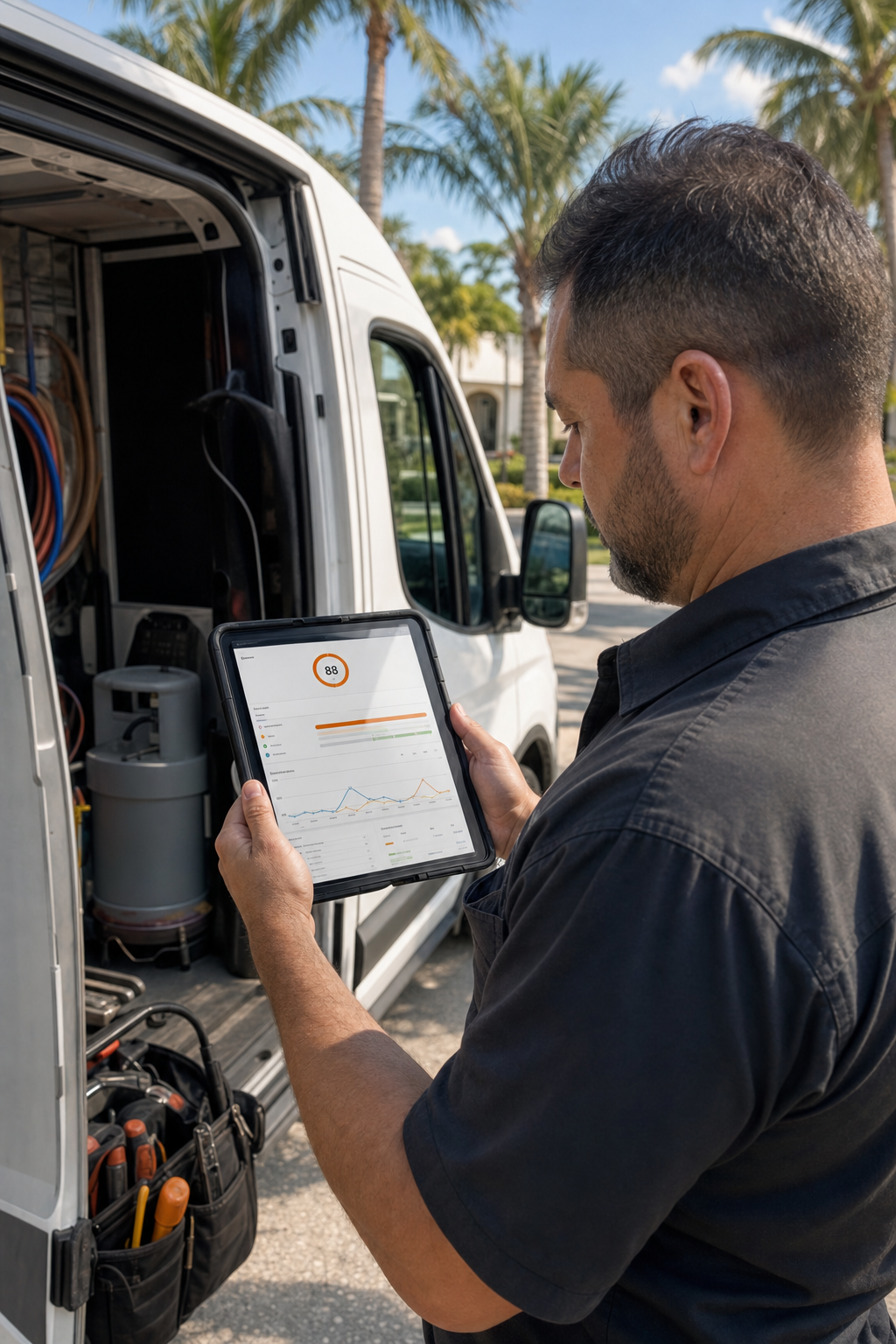
A slow, broken website cancels out everything else you do. Google can't rank a page it can't read, and a visitor who waits more than three seconds on mobile is already gone. Technical SEO is the foundation , and it's where most local businesses have the most unaddressed problems.
Start with Core Web Vitals. Google measures three things: Largest Contentful Paint (how fast the main content loads), Cumulative Layout Shift (whether the page jumps around while loading), and Interaction to Next Paint (how responsive the page feels). If your site scores poorly on any of these, it's competing at a disadvantage from the start. A Fort Lauderdale roofing site that cut load time from 6 seconds to 1.8 seconds saw mobile traffic jump 65% , not because of new content, but because the technical floor was fixed.
Next, check crawlability and indexation. Open Google Search Console and look for pages flagged as "Discovered , currently not indexed" or "Crawled , currently not indexed." These are red flags. If Google can't index your service pages, they don't exist in search. Fix your XML sitemap so it only includes pages you want indexed. Check your robots.txt to make sure you're not accidentally blocking important pages.
Internal linking matters more than most people realize. Orphan pages , pages with no internal links pointing to them , carry no authority and are hard for Google to find. Build a clear path from your homepage to your service categories to your individual service pages. For a Boca Raton contractor, that means a logical hierarchy: Services → Residential Roofing → Storm Damage Repair. Link equity flows down that path.
If your site uses JavaScript‑heavy frameworks, test what Googlebot actually sees. Testing tools can show you exactly what the crawler renders.
One thing worth noting: our research across 39 South Florida SEO providers found that technical SEO is listed as a core service by nearly every firm. But there's a difference between running an automated audit tool and actually fixing the root cause of crawl waste, schema errors, and render‑blocking resources. Ask any provider to show you the specific issues they found and the fixes they made , not just a PDF of flagged warnings.
For businesses that want to understand how technical changes connect to faster content updates and better search visibility, our post on AI-powered websites that update without developer delays covers how site structure and content agility work together.
For automated follow‑up that captures leads that would otherwise disappear, see why Boca Raton HVAC companies lose calls in July. The same automation mindset applies to review collection.
Step 3: Use AI-Assisted Content Creation (the Right Way)
AI content tools are everywhere right now. But here's the honest version: AI is use, not a magic button. It speeds up research and drafting. It does not replace the judgment of someone who knows your market, your customers, and your competitive landscape.
Many South Florida SEO providers mention AI, but only a handful back it with real results. The firms that do back their AI claims with actual outcomes tend to show the biggest traffic lifts. The rest are using “AI‑powered” as a marketing line with nothing behind it.
Here's how to use AI tools without falling into that trap. Start with keyword research. AI‑assisted tools can surface long‑tail local phrases faster than manual research, terms like “emergency AC repair Boynton Beach open Saturday” or “medspa Botox Delray Beach same day.” These are how real people search, especially with voice queries getting longer and more conversational.
Then use AI to draft service‑and‑city pages, not to stamp out identical templates. Each page needs a substantial amount of unique content; a Boca Raton roofing page and a West Palm Beach roofing page should not just swap the city name. The Boca page might reference the specific neighborhoods served, the local permit process, or storm patterns in Palm Beach County. That's what makes it a real page, not a thin doorway page that risks a manual penalty.
For video, a short 60‑to‑90‑second explainer for each core service, shot on your phone, posted to YouTube and your GBP, does more for local trust than any AI‑written paragraph. YouTube is the second‑largest search engine. A West Palm Beach plumber who posts a video titled “How to shut off your water main in an emergency” gets found by exactly the person who needs a plumber right now. If you're exploring video formats for your service business, video‑creation guides can help you think through structure before you hit record.
The content that gets cited by AI search engines like Perplexity and ChatGPT follows a clear pattern: direct answers to specific questions, structured with clear headings, backed by local specifics. The discipline has always centered on matching content to user intent; AI tools change the speed of production, not the core principle.
At Media Ops Machine, we use AI to speed up the research and drafting phase, then apply 30 years of marketing experience to make sure the output actually reflects how South Florida buyers think and search. AI writes a draft. A human who knows this market makes it useful.
Step 4: Optimize Local Listings and Reviews

Your Google Business Profile is your storefront for the majority of local searchers who never visit your website. Over 60% of local searches now end without a website click , the phone number, hours, and reviews are right there on the results page. If your GBP isn't optimized, you're invisible to that majority.
Complete every field. Business description, hours (with holiday hours updated), services with individual descriptions, attributes, products, and the Q&A section. A complete profile gets significantly more direction requests and builds more customer trust than a partial one.
Photos matter more than most business owners think. GBP profiles with photos get 42% more direction requests than those without. Upload exterior shots, interior shots, team photos, and work-in-progress images. For an HVAC company in Delray Beach, that means photos of your techs on the job, your service vans, and your office. Add new photos at least monthly , Google uses recency as a signal that your business is active.
Reviews are a ranking signal, not just a trust signal. The cadence matters: 3, 8 new reviews per month, year‑round, is the target for South Florida service businesses. Not a burst of 50 reviews in one week , that pattern looks suspicious. The workflow that works is a tap‑to‑review link sent via SMS after every closed service ticket, with an owner response within 24 hours. Google can detect templated boilerplate responses, so the response should sound like you.
For businesses that want to understand how automated follow‑up captures leads that would otherwise disappear, missed call text‑back systems are one of the highest‑ROI tools for local service businesses , the same automation mindset applies to review collection.
Citation consistency is the unglamorous work that moves rankings. Every directory listing, such as Yelp, BBB, and industry‑specific sites like Houzz for home services or ZocDoc for medical, needs to match your GBP exactly. NAP drift happens because no one is responsible for it. Make citation audits a quarterly line item, not a one‑time task.
Our local SEO and Google Business services handle all of this end‑to‑end: GBP optimization, citation management, review request automation, and monthly photo and post cadence. The goal is to make sure no lead slips through because your listing was incomplete or your reviews went quiet.
Need deeper guidance? Visit our MOM Answer Hub for step‑by‑step playbooks.
Step 5: Track Results and Iterate with Human Insight
Most agencies send you a monthly report full of organic keyword rankings and call it done. That's the wrong measurement for a local service business. Organic rank and local pack rank are different. The local pack is where the calls come from. If you're not tracking local pack rank from the geographic centroid of your service area, you're flying blind.
Set up the right tracking stack. Google Business Profile data shows you calls, direction requests, and profile views; these are actual customer actions, not vanity metrics. Add call tracking so you know which keywords and which pages are driving real phone calls. Use a local rank tracker (or equivalent tool) for your top five service-and-city combinations. That tool shows you where you rank across your entire service area, not just from your business address.
Track these numbers monthly, not weekly. SEO compounds over time. A medspa in Boca Raton that moves from position 6 to position 3 in the local pack for "Botox near me" doesn't see the result in week one, it shows up as a steady increase in calls over 90 to 180 days. Patience is part of the strategy, but you need data to know whether the work is moving in the right direction.
When something isn't working, look at the data before you change the strategy. If GBP views are up but calls are flat, the problem is probably the listing itself, weak photos, no service descriptions, or reviews that haven't been responded to. If local pack rank is improving but conversion is low, the problem might be your website's mobile speed or your follow‑up system. Each symptom points to a different fix.
The South Florida market, Broward, Palm Beach, and Miami‑Dade combined, is densely populated and highly competitive. Fort Lauderdale alone has over 400 law firms competing for the same local pack slots. Contractors, HVAC companies, and medspas face similar density. In a market this competitive, the businesses that iterate based on real data pull ahead of the ones running the same playbook month after month.
AI tools can surface patterns in your data faster than manual review. But the decision about what to do with those patterns, which service page to build next, which neighborhood to target, which review to respond to personally, still requires human judgment. That's the honest version of "AI‑powered marketing": AI handles the volume; experienced people handle the strategy.
If you want a usable framework for nurturing leads after they come in, not just tracking them, lead nurturing strategies built around segmentation and automation pair well with a strong local SEO foundation. Getting the call is step one. Converting it is step two.
The our local marketing answer hub covers the most common questions South Florida business owners ask about local pack rankings, GBP optimization, and how long results take, with direct, plain‑language answers based on what we actually see in this market.
Need quick answers? Check out the Local Marketing Answer Hub for FAQs and quick wins.
FAQ
How long does SEO optimization take to show results in South Florida?
You'll typically see measurable improvements in Google Business Profile views and local pack rankings within 60, 90 days of consistent work. Full local pack rankings for competitive terms like "HVAC repair Boca Raton" or "plumber Fort Lauderdale" can take 3, 6 months. The South Florida market is dense , Broward County alone has hundreds of plumbing companies , so results compound over time rather than arriving overnight.
What's the difference between local SEO and regular SEO?
Regular SEO targets organic search rankings for any audience. Local SEO targets the Google Maps local pack and location-specific search results for people searching near your business. Local SEO depends heavily on your Google Business Profile, NAP citation consistency, and review volume , factors that don't apply to national organic rankings. For a service business in Delray or Boynton, local SEO is almost always the higher-ROI investment.
Do I really need to respond to every Google review?
Yes. Google uses review recency and owner response patterns as ranking signals. Unanswered reviews , especially negative ones , signal an inactive or unengaged business. Respond to every review within 24 hours. Keep responses specific to what the reviewer said, not boilerplate copy. Google can detect templated responses, and real customers read them before deciding whether to call you.
Is AI actually useful for local SEO, or is it just hype?
It's useful for specific tasks: keyword research, first drafts of service-and-city pages, and data analysis. It is not a replacement for local market knowledge or experienced strategy. Of the 39 South Florida SEO providers we analyzed, only 18% mention AI at all, and the ones with real AI capabilities back it with measurable traffic results. "AI-powered" as a marketing label without substance behind it is common , ask any provider what the AI actually does.
How many reviews do I need to rank in the local pack?
There's no fixed number, but cadence matters more than total count. A steady flow of 3, 8 new reviews per month signals an active business to Google's algorithm. A one-time burst of 50 reviews followed by silence can look suspicious. Focus on building a consistent review request process , an SMS sent after every completed job works well for HVAC companies, contractors, and medspas across South Florida.
What should I track to know if my SEO optimization is working?
Track local pack rank (not just organic rank), Google Business Profile calls and direction requests, and phone call volume tied to specific keywords. Organic traffic is a secondary metric for local service businesses , the local pack drives the calls. Use a local rank tracker that shows your position across your full service area, not just from your business address. That geographic view is where the real data lives.
Conclusion
SEO optimization for a South Florida service business comes down to five things done consistently: a complete audit, a solid technical foundation, content that matches how local buyers actually search, listings and reviews that stay active, and tracking that measures what actually drives calls. If you want 30 years of real marketing experience applied to your local search presence , not a template, not a buzzword , that's what we do at Media Ops Machine. Book a free assessment and we'll tell you exactly where you stand. No commitment, no sales pitch.