
Media Ops · How-to / Guide
How to Build a Media Ops Workflow That Launches Faster
Media Ops Machine · · 6 min read
A media ops workflow is the difference between a team that ships campaigns on schedule and a team that spends its week chasing missing assets, re-trafficking creative and re-checking tracking tags. When everyone knows where a request enters, who owns each stage and what has to be true before a campaign goes live, launches get faster and errors get rarer. This guide maps the five core stages of a media ops workflow, the owners and checkpoints that hold it together, and the two numbers that tell you it is actually working.
What a media ops workflow actually is
Media ops, short for media operations, is the system that turns a campaign idea into a live, correctly tracked, well-reported buy. It sits between strategy and the ad platforms. In most teams the work hides in email threads and spreadsheets: a request arrives in a DM, a brief gets rewritten three times, a tracking tag goes missing, and someone notices on launch day that the wrong creative is running.
A defined workflow replaces that improvisation with a repeatable path. Five stages cover almost every paid media program:
- Intake: how a campaign request enters the system
- Build: how the brief becomes campaign structure, creative and tracking
- QA: how errors are caught before anything goes live
- Launch: how the campaign is trafficked and shipped cleanly
- Reporting: how performance feeds the next round of work
The stages are simple. The discipline is in naming an owner for each one and never letting a stage skip its checkpoint.
Stage 1: Intake
Intake is where most media ops problems are born. When requests arrive in five different formats, the team rebuilds context every time. Standardize it. Every request should land in one place with the same required fields: objective, budget, flight dates, target audiences, markets, creative assets and success metrics.
The intake owner does not do the work. They confirm the request is complete enough to build. A request missing its tracking requirements or its flight dates does not move forward. That single rule prevents the rework that eats a launch week.
Stage 2: Build
Build is where the brief becomes something a platform can run. That means campaign structure and naming conventions, audience and placement setup, creative assignment, and tracking tags that match the reporting the client expects.
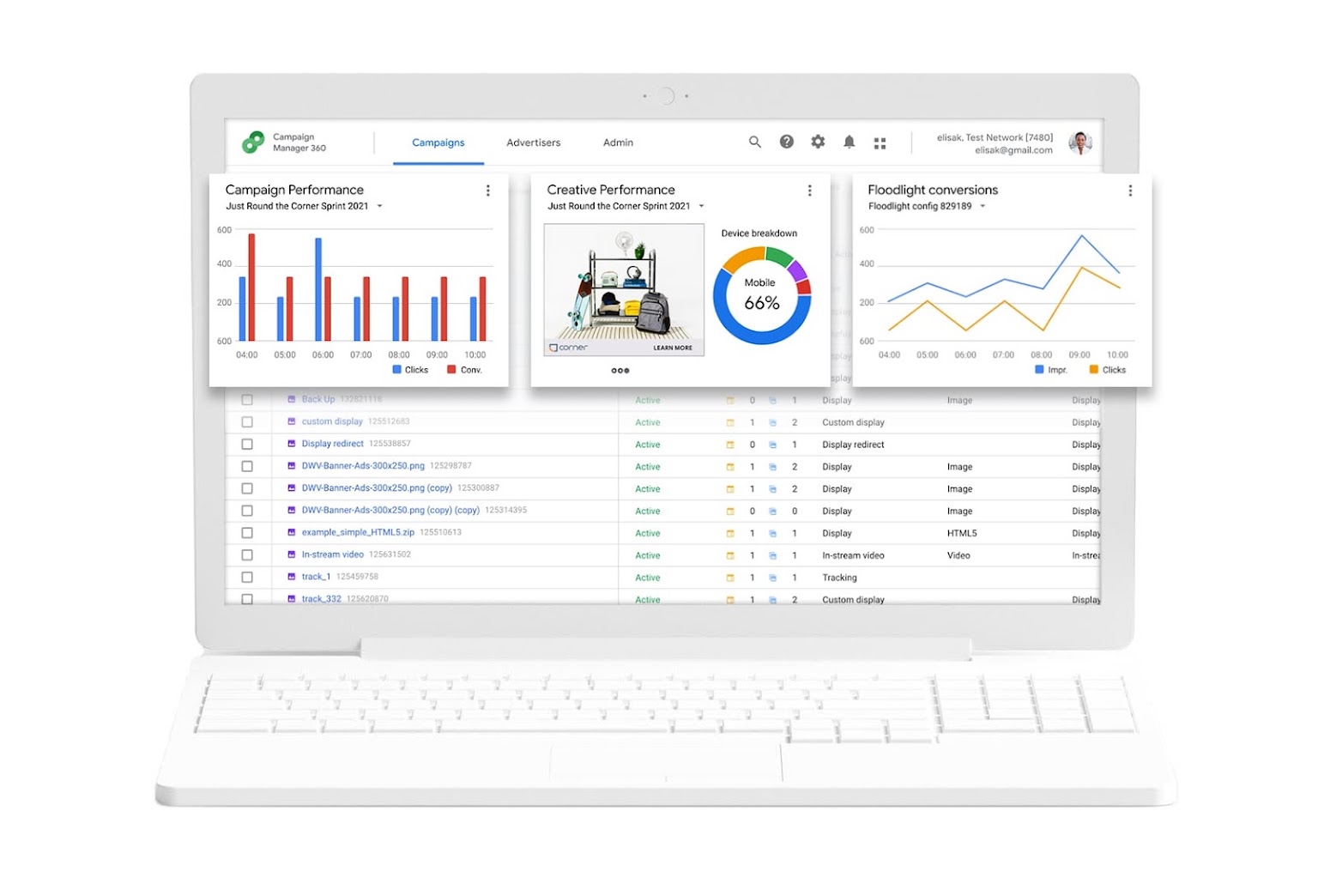
For teams running Google Campaign Manager 360 or similar ad servers, build includes the trafficking details: placements, ads, and the floodlight or conversion tags that tie spend to outcomes. A consistent naming convention is not cosmetic. It is what makes reporting possible later without manual cleanup.
The build owner's checkpoint is simple: hand off a structure that a reviewer could run exactly as written, with no verbal instructions attached.
Stage 3: QA
QA is the stage teams skip when they are behind, and it is the stage that saves them. A media ops QA pass checks the things that are expensive to fix after launch: correct creative version, accurate landing page URLs, working tracking tags, matching budgets, approved geos and placements.
Treat QA as a checklist, not a vibe. One person who did not build the campaign reviews it against that checklist and signs off. Separation between build and review is what catches the error the builder has gone blind to.
The QA checkpoint is binary. Either the campaign passes and moves to launch, or it goes back to build. No partial passes, no "we will fix it live."
Stage 4: Launch
Launch is the moment of truth, and it should be the boring part. By now the campaign is built, reviewed and approved. The launch owner traffics it, confirms it is serving, verifies tracking is firing and checks that spend is pacing as planned in the first hours.
A short launch checklist keeps it tight: confirm the campaign is active, confirm impressions are registering, confirm conversion tracking works, confirm the creative shown matches the approved version. Once those four are true, the campaign is genuinely live and not just "set to active."
Stage 5: Reporting
Reporting closes the loop. A good media ops workflow reports on a fixed cadence using the naming convention and tracking established at build. That consistency is what lets you compare campaigns instead of rebuilding the story every month.
Reporting is also feedback. When a campaign underperforms, the report should point back to a specific stage: was the audience wrong, the creative off brief, the tracking broken, or the offer weak? That signal is what makes the next launch better.
Assign owners and checkpoints at every stage
A workflow without owners is just a diagram. Name one person accountable for each stage, even if the same person owns two. The owner is responsible for that stage's checkpoint, not for doing every task inside it.
Checkpoints are the gates between stages. Intake is not done until the request is complete. Build is not done until it is reviewable. QA is not done until it passes the checklist. Launch is not done until serving and tracking are confirmed. Reporting is not done until the findings route back to the next intake.
Measure the two numbers that prove the workflow is working
You do not need a dashboard to know whether your media ops workflow is healthy. Track two numbers.
The first is launch speed: the time from a complete intake to a live campaign. Watch how that number moves over a quarter. If it shrinks, the workflow is removing friction.
The second is error rate: the share of campaigns that need a fix at or after launch, whether that is a tracking issue, a wrong creative or a budget mistake. Track where each error originated. A rising error rate almost always points to a stage whose checkpoint is being skipped.
Compare the two together. Faster launches with a stable error rate mean the process is tightening. Faster launches with a rising error rate mean speed is being bought by cutting QA, and that catches up with you.
Where a white-label media ops team fits
Not every brand or agency needs to build every stage in-house. A white-label media ops team can own trafficking, QA and reporting while your team keeps strategy and client relationships. That is often how agencies scale delivery through a busy quarter without adding headcount, and how brand teams keep campaigns moving when internal capacity is thin.
The workflow does not change when it is outsourced. The stages, owners and checkpoints stay the same. Only the people filling the seats change.
The takeaway
A media ops workflow turns campaign delivery from a scramble into a system. Define the five stages, name an owner and a checkpoint for each, and measure launch speed against error rate. Do that, and campaigns launch faster because the work stops colliding, and errors get rarer because nothing goes live without passing a gate.
If you would rather not build the whole operation from scratch, Media Ops Machine runs media ops as a done-for-you and white-label service, covering campaign strategy, buying, ad operations and reporting.
Need help getting campaigns out the door?
Talk with Media Ops Machine about campaign setup, trafficking, QA and reporting support for your agency or brand.
Book a Call